

Looking natural on camera has less to do with confidence or talent than most people think. It comes down to knowing what you want to say, practicing it out loud, and having someone behind the camera who can direct you. I started in front of the camera filming myself, and I've spent the last 7 years filming and directing other people for business videos. I've worked with owners who love an audience and people who'd rather be anywhere else, and the ones who look natural are usually the ones who prepared.
Being good at your job doesn't make you comfortable on camera. I've filmed people who can explain their business all day in conversation and then struggle to get through three sentences once I hit record. You don't have to be a natural. It just helps to know how filming works.
The short version
- Practice your script out loud for about 10 minutes a day before the shoot.
- Expect the first few takes to be warm-ups. The good one usually shows up around take four to six.
- Sit tall, drop your shoulders, and use your hands the way you would in conversation.
- Give more energy than feels normal. On camera, it reads as confident.
- Wear solid colors and skip thin stripes, small checks, and shiny fabrics.
Why people look stiff on camera
Most people get stuck in their own heads. The camera turns on and they start checking everything at once: Am I looking at the right spot? Am I sitting up straight? Did I say that right? What's the next line? They stop talking to anyone and start trying not to make mistakes, and their personality disappears.
How you say it matters more than getting every word exact.
The facts have to be right, but a word-perfect read that nobody connects with doesn't help you. Think about how you'd explain your business to someone who just walked into your office. You wouldn't rehearse the wording in your head first. You'd just talk to them, and that's what I'm trying to capture.
If it helps, the discomfort is normal. One marketing company that started filming its own team found that its smoothest speakers started stumbling once the camera was on. I've done this for years, and talking straight into a lens still makes me uncomfortable. It takes a long time for that feeling to go away, if it ever does. The goal is to get comfortable enough to stop thinking about the camera and start thinking about the person watching.
How to prepare before your video shoot
If I could get everyone to do one thing before a shoot, it would be to practice the script out loud. I can usually tell within a few takes whether someone has read their script before or is seeing it for the first time.
A script can look fine on a screen and still trip you up when you say it. A sentence runs too long, or there's a word you'd never actually use. You want to find those before the camera is rolling.
The rest of the prep is simple:
- Have your outfits, grooming, and any makeup sorted before the shoot.
- Clean up the areas we'll film and clear anything you don't want in the background.
- Leave room in your schedule so you aren't rushing in from an appointment.
- If it's a working office, think about phones, nearby conversations, and other noise.
I handle the lighting, audio, and framing. Your message, your appearance, and your space are what you bring, and all three show up in the finished video.
Script, teleprompter, or talking points?
I bring a teleprompter to every shoot. It lets you read your script while keeping eye contact with the lens, so you don't have to memorize anything or look down at notes. It's there to help your delivery, though, and it shouldn't run the show.
People write more formally than they talk, and a polished script can sound stiff when it's read word for word. Teleprompter guides recommend writing the way you speak, rehearsing out loud, and setting the scroll speed to your pace instead of chasing the text. Sometimes I need to go further than that.
Say I'm filming a chiropractor explaining a first visit, and the script reads: "Upon arrival, patients undergo a comprehensive evaluation of their spinal condition utilizing our established clinical assessment procedures." It might be accurate, but nobody talks like that. If it isn't working, I stop the teleprompter and ask, "Forget the script. If I called your office and asked what happens on my first visit, what would you tell me?" Now they're explaining their own business to me, and they say something like, "We'll talk about what's bothering you, check how you're moving, and go over next steps." That's the delivery I want, and I can shape the script around the way they actually talk. It matters most in videos like a chiropractor's first-visit video, where putting a nervous patient at ease is part of the message.
Some people do great on a teleprompter. Others do better with talking points or an interview. The right method is whichever one lets you talk clearly and comfortably.
How many takes it takes to look natural
You don't have to get it on the first take, and most people don't. With someone new to filming, I expect a warm-up. The first couple of takes are for settling in. By the third or fourth, people find their rhythm, and that's when I start adjusting pace, posture, and delivery. For a short section, the good take usually shows up somewhere between the fourth and sixth. That's from experience, not a study, and some people get it right away.
We're usually not running the whole script each time, either. It might be two or three lines, so the first few attempts take about a minute.
More takes don't always help. After too many runs at the same lines, people start picking at tiny details and stiffen up again. When I see that, I change the approach. I'll rework the line, have a quick conversation, or move on and come back to it later.
What to do with your hands, shoulders, and posture
Body language is usually the first thing I adjust. The three things I see most are leaning forward, shoulders creeping up, and hands locked in front of the body. They make people look closed off even when they're saying all the right things.
I start with posture. Picture a string pulling the top of your head up, sit or stand tall, then roll your shoulders back and down. That puts you in a good starting position without posing.
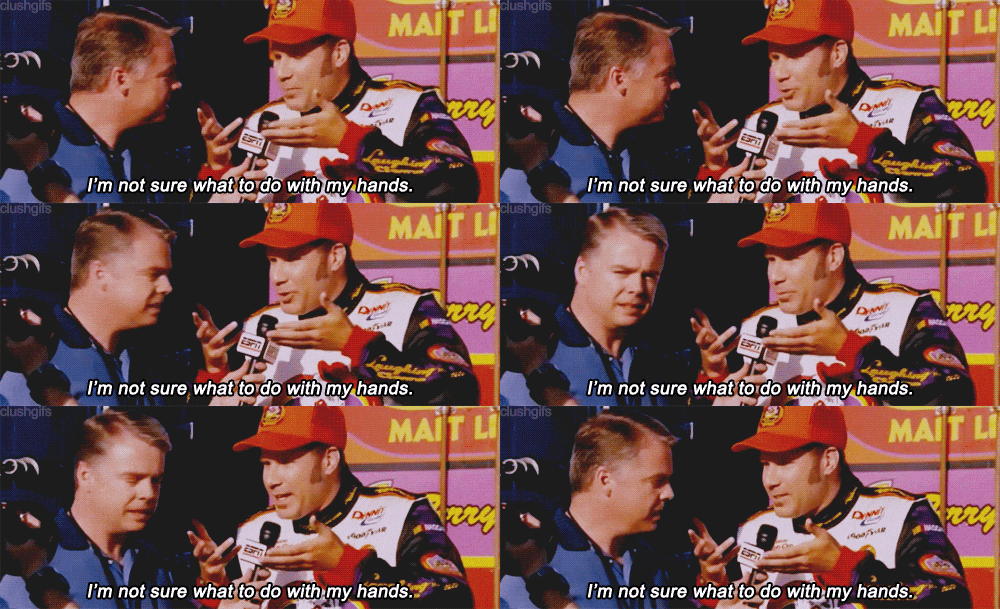
Then the hands. If you don't know what to do with yours, you're in good company. That's at least half the people I work with, and it's completely normal. Helping with that is part of my job. Some people freeze their hands, and some fidget. Use your hands the way you would in a normal conversation. Sometimes I'll stop recording and just talk with someone for 15 seconds to see how they move when they forget about the camera, then bring that into the next take. Body language on video carries a lot of the message, because viewers see how you say something, not just what you say.
How to sound more confident on camera
A lot of people have a perfectly normal speaking voice until the camera turns on. Then they get quieter and flatter. The microphone picks them up fine. They've just lost the energy they'd have in person.
This isn't shouting or faking a personality. If you're telling people why they should trust your business, you need to sound like you believe it.
Should you look directly into the camera?
It depends on the video. If you're talking to customers, like welcoming new patients to your practice, look into the lens so viewers feel like you're talking to them. That doesn't mean staring without blinking. Glance away now and then, the way you would in a real conversation.
Interviews and testimonials work differently. I sit just off-camera and you talk to me, so the camera is watching a conversation. A direct-to-camera intro should feel personal. An interview should feel like a conversation the viewer gets to listen in on.
What to wear on camera
Wear something you'd be comfortable representing your business in. If you're fussing with your outfit or your hair, that's attention you're not putting into the message.
Solid colors are a safe place to start. Skip thin stripes, small checks, and tight patterns, which can shimmer on camera, along with big logos and shiny fabrics that pull attention off your face. A few other things I mention to clients:
- Darker clothing tends to be more slimming, but fit and lighting matter as much as color.
- Necklaces and bracelets can rub against a microphone and show up in the audio.
- Matte makeup, or anything that controls shine, helps under lights. Shine on skin is hard to fix in the edit.
- If we're filming outdoors in Fort Lauderdale, plan for wind and pick a hairstyle that won't blow across your face.
If you're filming several videos in one day, have your outfits ready ahead of time so changes go quickly.
Can editing fix mistakes?
To a point. You don't need to get through the whole script in one perfect take. I break a business video into sections, or beats. A business introduction might have three: welcome the viewer and introduce the business, explain what you do or what to expect, and close with the next step. Each one needs to feel complete, and if a longer passage isn't working, we break it into smaller pieces.
In the edit, b-roll (footage of your team, your space, and your work) covers the joins between sections, and the audio can carry across a cut so it still sounds like one thought. Editing can remove mistakes, trim pauses, and smooth out the pacing.
What it can't do is make a tense, disconnected delivery look confident. If every sentence is recorded separately with a different energy, the cut feels choppy. That's why I'd rather film complete thoughts and fix the delivery while we're shooting.
How a director helps you look natural
While we film, I'm watching things the person on camera usually isn't thinking about: posture, hands, tone, and whether they actually look comfortable. Sometimes I'll play back a take that worked so they can see it. Other times I'll show one where they're leaning in or their tone has shifted, because it's easier to see than to explain. I pick one or two things to work on, not ten.
A lot of my job is taking pressure off. That might mean turning off the teleprompter and having a conversation, doing a few practice takes, or reminding someone they don't have to nail it right away.
It also gets easier with repetition. Some of the best people I've filmed are clients who shoot with me regularly, which is one of the upsides of filming social media videos on a regular schedule. Every session is practice for the next one. The info video below was filmed straight to camera, with on-screen captions for people watching on mute.
What if you don't like how you look or sound?
I get it. I've been behind the camera for years, and I still don't enjoy watching myself. You're your own harshest critic, and you'll notice your voice, an expression, or the angle of your head when nobody else does. Some of that is useful. A lot of it is just pressure.
When I review a take, I look for two things: does it sound natural, and does it tell the viewer what they need to know? If both are yes, the take is probably doing its job. Preparation still matters, but past a certain point, chasing perfection works against the video. A business owner who's relaxed, clear, and knows their work comes across better than someone so focused on looking perfect that they lose their personality.
Before you film
You don't need to become a professional presenter. Read your script ahead of time and say it out loud. Get your outfit and your space ready. Don't expect to nail the first take. And once we're rolling, talk to the person watching, not the camera.
I handle the technical side and direct you through the delivery, whether it's a website introduction, an interview, or a batch of social media videos. You can learn more about our video production in Fort Lauderdale, see our video packages, or read what goes into the cost of a business video.
Have a shoot coming up?
We'll handle the camera and walk you through the rest.
Rather talk first?